TonicNest may earn a commission if you buy through links on this page, at no extra cost to you. That does not change what we report.
Part of our Digestsync overview. Last checked October 19, 2026.
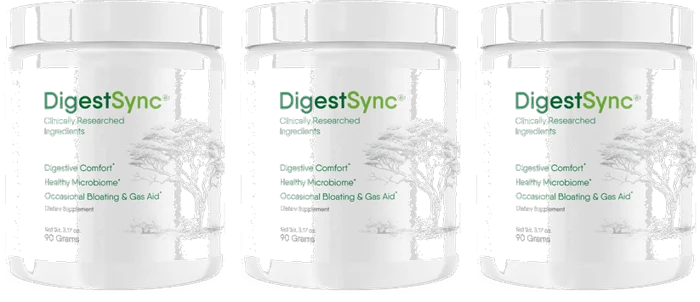
DigestSync ingredients are pea starch, wildcrafted baobab, Sukre, konjac glucomannan and biogenic polyamines, packed into one 2.4 g proprietary blend inside a 3 g scoop[1]. The label also lists silicon dioxide, natural flavors and stevia. It prints no amount for any single ingredient, so nobody outside the company knows how much konjac or baobab you get per serving.
Digestsync ingredients at a glance
All five active ingredients sit in one blend, and every grade below is Weak except konjac for cholesterol. The vendor does not explain what each ingredient is for, so the second column says what the ingredient is.
| Ingredient | What it is | Amount disclosed? | Evidence grade |
|---|---|---|---|
| Pea starch | Starch from peas | No, share of 2.4 g | Weak |
| Wildcrafted baobab | Fruit powder | No, share of 2.4 g | Weak |
| Sukre | Purified L-arabinose, a sweetener | No, share of 2.4 g | Weak |
| Konjac glucomannan | Soluble fiber from konjac root | No, below 2.4 g | Moderate (LDL), Weak (weight) |
| Biogenic polyamines | Type and source not stated | No, share of 2.4 g | Weak |
| Silicon dioxide | Anti-caking agent | No | Not graded |
| Natural flavors | Flavoring | No | Not graded |
| Stevia | Sweetener | No | Not graded |
What is in each ingredient, and what does research say?
Each active ingredient has some human research, but none was tested inside DigestSync, and the studied doses are mostly far above 2.4 g.
Pea starch
We found no human trial of plain pea starch as a supplement. The one pea starch paper we read covers food processing, not health[2]. Resistant starch as a class lowered total cholesterol by 7.3 mg/dL and LDL by 3.4 mg/dL across 20 trials[3], lowered fasting glucose slightly[4] and shifted gut bacteria[5]. Effects were clearer above 20 to 28 g a day. How much of DigestSync's pea starch is resistant is not stated. Grade: Weak.
Wildcrafted baobab
Baobab extract lowered the blood sugar response to white bread in a small one-off test, with no effect on fullness[6]. In 20 adults, 15 g in a smoothie lowered self-rated hunger for a day but did not change calories eaten at the next meal[7]. No trial looked at digestion, bowel habits or weight. Grade: Weak.
Sukre
Sukre is a trademarked, purified L-arabinose sweetener made from acacia. The vendor never explains it; that definition comes from a toxicology paper[8]. L-arabinose blocks the enzyme that breaks down table sugar. In 12 adults, 7.5 g taken with 50 g of sucrose lowered the glucose peak from 8.2 to 6.6 mmol/L[9]. In 18 adults with impaired fasting glucose, it had no effect over 2 days of mixed meals[10]. DigestSync is taken in water before breakfast, not with sugar. Grade: Weak.
Konjac glucomannan
Konjac is a soluble fiber with the most data in this formula. About 3 g a day lowered LDL by roughly 10% across 12 trials[13], and an earlier pooled study found LDL down 16 mg/dL and fasting glucose down 7.4 mg/dL[12]. For weight, 8 trials showed a 0.22 kg difference that was not significant[11]. Constipated children had 1.4 more bowel movements a week[14]. Grade: Moderate for LDL, Weak for weight.
Biogenic polyamines
The label does not say which polyamines or where they come from. The main human trial gave 0.9 mg a day of spermidine from wheat germ to 100 older adults for 12 months and found no effect on memory or biomarkers[15]. A 28-day trial at 40 mg a day only checked safety[16]. No digestive or weight trials were found. Grade: Weak.
Silicon dioxide, natural flavors and stevia
These are the non-active ingredients: an anti-caking agent, flavoring and a sweetener. We did not research them for this product. Together with the blend they make up the 3 g scoop, and the label gives no amount for any of them. Stevia and Sukre together mean the powder is sweetened twice, once by stevia and once by L-arabinose.
How transparent is the Digestsync formula?
The formula is only partly transparent: you get the names, not the amounts. A 3 g scoop holds the 2.4 g blend, so roughly 0.6 g is left for silicon dioxide, flavors and stevia. If the five actives were split evenly, each would be under half a gram, but the company does not say how the blend is split.
That matters because the one dose with real support, about 3 g of konjac for LDL, is larger than the whole blend. The label also calls these "Clinically Researched Ingredients" and the FAQ calls the blend "optimally dosed" while showing no doses[17].
Some third-party pages list a different formula, without Sukre, and add an FDA badge. Trust the label printed on the jar you receive. The ingredient list here matches the vendor label as checked October 19, 2026.
Ingredient safety and interactions
The main known safety issue is konjac. It can cause gas, bloating, belching, loose stools or constipation[11]. Konjac tablets caused esophageal blockages in the 1980s[18], while DigestSync is a powder, so mix each scoop fully in the stated 8 to 16 oz of liquid.
No interaction studies were found for any ingredient. Konjac lowered fasting glucose in pooled trials[12], so people on diabetes medicines should ask their doctor first. The label itself tells pregnant or nursing women, under-18s and anyone with a medical condition to check with a doctor. Details are on our DigestSync side effects page.
Do these ingredients prove Digestsync works?
No. Ingredient studies used other doses, other outcomes and, for Sukre, a different way of taking it. None tested this blend, and none studied the vagus nerve or bowel "clockwork" the sales page promises.
Our does DigestSync work guide lines up each vendor claim against the evidence. If you want to test it yourself, the price and package guide shows the cost per day, and the refund runs 60 days from delivery.
Back to the Digestsync overview.
Frequently asked questions
What is Sukre in DigestSync?
Sukre is a trademarked, purified L-arabinose sweetener made from acacia. The DigestSync vendor never explains it. In human tests L-arabinose blunted blood sugar spikes only when eaten together with table sugar, at 7.5 g per 50 g of sucrose.
How much konjac is in a scoop of DigestSync?
The label does not say. Konjac glucomannan is one of five ingredients in a 2.4 g proprietary blend, so it is below 2.4 g. The LDL cholesterol benefit seen in trials needed about 3 g a day.
Does DigestSync contain probiotics?
No probiotic strains appear on the DigestSync label. The blend lists pea starch, wildcrafted baobab, Sukre, konjac glucomannan and biogenic polyamines, plus silicon dioxide, natural flavors and stevia as other ingredients, as checked October 19, 2026.
Is DigestSync sweetened?
Yes. The other ingredients include stevia and natural flavors, and Sukre, one of the blend ingredients, is itself an L-arabinose sweetener. The label lists no added sugar among the other ingredients.
Why do some sites show a different DigestSync formula?
Some third-party pages show a different list that leaves out Sukre and add an FDA badge. The label on the vendor site lists Sukre. Go by the supplement facts panel on the jar you actually receive.
Sources
- DigestSync product page and label image. DigestSync, read October 19, 2026.
- Johansson et al. 2026, pea starch as a food ingredient. PubMed, read October 19, 2026.
- Resistant starch and blood lipids, meta-analysis of 20 trials. PubMed, read October 19, 2026.
- Resistant starch and glucose control, meta-analysis of 19 RCTs. PubMed, read October 19, 2026.
- Resistant starch and gut bacteria, meta-analysis of 7 studies. PubMed, read October 19, 2026.
- Coe et al. 2013, baobab extract and glycemic response to white bread. PubMed, read October 19, 2026.
- Garvey et al. 2017, baobab fruit and satiety, crossover trial. PubMed, read October 19, 2026.
- Dziwenka et al. 2026, toxicology of purified L-arabinose (Sukre). PubMed, read October 19, 2026.
- Pasmans et al. 2022, L-arabinose with sucrose and blood glucose. PubMed, read October 19, 2026.
- Pretorius et al. 2025, L-arabinose in adults with impaired fasting glucose. PubMed, read October 19, 2026.
- Onakpoya et al. 2014, glucomannan and body weight, meta-analysis of 8 RCTs. PubMed, read October 19, 2026.
- Sood et al. 2008, glucomannan effects on lipids, glucose and weight, meta-analysis. PubMed, read October 19, 2026.
- Ho et al. 2017, konjac glucomannan and LDL cholesterol, meta-analysis of 12 RCTs. PubMed, read October 19, 2026.
- Glucomannan for constipation in children, meta-analysis of 3 RCTs. PubMed, read October 19, 2026.
- Schwarz et al. 2022, SmartAge spermidine trial. PubMed, read October 19, 2026.
- Keohane et al. 2024, spermidine safety trial in healthy men. PubMed, read October 19, 2026.
- DigestSync contact and FAQ page. DigestSync, read October 19, 2026.
- Glucomannan tablets and esophageal obstruction, Australian case series. PubMed, read October 19, 2026.
This page is general information, not medical advice. Dietary supplements are not reviewed by the FDA for safety or effectiveness before they are sold and are not intended to diagnose, treat, cure or prevent any disease. Talk to your doctor before taking any supplement, especially if you are pregnant, nursing, take medication or have a health condition.